
Bringing a new puppy home is exciting. Those tiny paws, that wobbly walk, and that sweet puppy smell can melt anyone’s heart. But if you already have an older dog, you may be wondering how your senior friend will feel about the new arrival.
The good news is that most older dogs can learn to love a puppy — with a little patience and a calm plan. Older dogs often enjoy the company once they get used to it, and puppies can learn good manners from a steady older dog. The key is to take it slowly. Do not rush the first meeting, and do not expect them to become best friends on day one.
Before the First Meeting
A little preparation goes a long way. Before your puppy comes home, set up the house so both dogs have their own space.
Give your older dog a safe place to rest where the puppy cannot follow — a quiet room, a crate with the door open, or a comfy bed in a corner. Older dogs often need more rest than puppies, and they should always be able to walk away when they have had enough.
Set up a separate area for the puppy too, with its own bed, food bowl, water bowl, and toys. Keeping their things separate at first helps prevent arguments over food and favourite toys.
If your older dog has never lived with another dog before, the ideas in our guide on how to introduce a rescue dog to your home in the first week can help you think about settling a new dog in gently.
Step 1: Meet on Neutral Ground
The first meeting should not happen inside your house. Your older dog may feel that its home is its territory, and a bouncy puppy bursting through the front door can feel like an invasion.
Instead, meet somewhere neutral, like a quiet street or a calm corner of a park. Ask a helper to handle one dog while you handle the other, keep both dogs on leads, and let them see each other from a distance first.
Walk them side by side, a few metres apart, in the same direction. This parallel walk is one of the best ways for dogs to meet: walking together feels natural, and it lets them notice each other without the pressure of a face-to-face greeting.
If both dogs look relaxed — loose bodies, soft eyes, tails wagging at a natural height — you can slowly let them get a little closer. Let them sniff each other briefly, for just a few seconds, then call them apart and reward them with a treat. Short, happy meetings are much better than one long, tense one.
If either dog stiffens, stares hard, growls, or tries to pull away, do not force it. Calmly increase the distance and try again later. Some dogs need several short meetings before they feel comfortable.
Step 2: Bring Them Home Calmly
Once the outdoor meeting has gone well, it is time to go home — but keep things calm. Bring the older dog inside first, then bring the puppy in a few minutes later. This small step helps your older dog feel that its home is still its own.
Let the puppy explore one room at a time, rather than giving it the run of the whole house at once. Too much space can overwhelm a puppy, and it can also stress an older dog that suddenly feels its whole world has changed.
Keep the first home meetings short and supervised. If the puppy gets too wild — jumping on the older dog, nipping at its ears, or chasing it — gently step in and guide the puppy to its own area for a calm break. Puppies have huge energy and very little self-control, and it is your job to protect your older dog’s peace.
For the first few days, keep the dogs in separate rooms when you cannot watch them. This is not a punishment — it simply lets them get used to each other’s smell and sounds without any pressure.
Step 3: Manage Mealtimes and Resources
Food, treats, toys, and favourite beds can cause tension between dogs, especially in the early days. The simplest way to avoid trouble is to keep things separate.
Feed the puppy and the older dog in different rooms, or at least on opposite sides of the room. Pick up the bowls when mealtime is over. Do not leave food lying around for them to argue over.
The same goes for high-value treats like chews and bones. Give these only when the dogs are apart. Chews are wonderful for puppies, but they can turn even a gentle older dog grumpy if a puppy tries to steal one.
Toys can be shared eventually, but at first, give each dog its own toys. If one dog guards a toy — standing over it, stiffening, or growling when the other comes near — calmly remove the toy and try again another day. Guarding is a sign that the dog needs more space and time, not a reason to scold.
Step 4: Teach the Puppy Good Manners
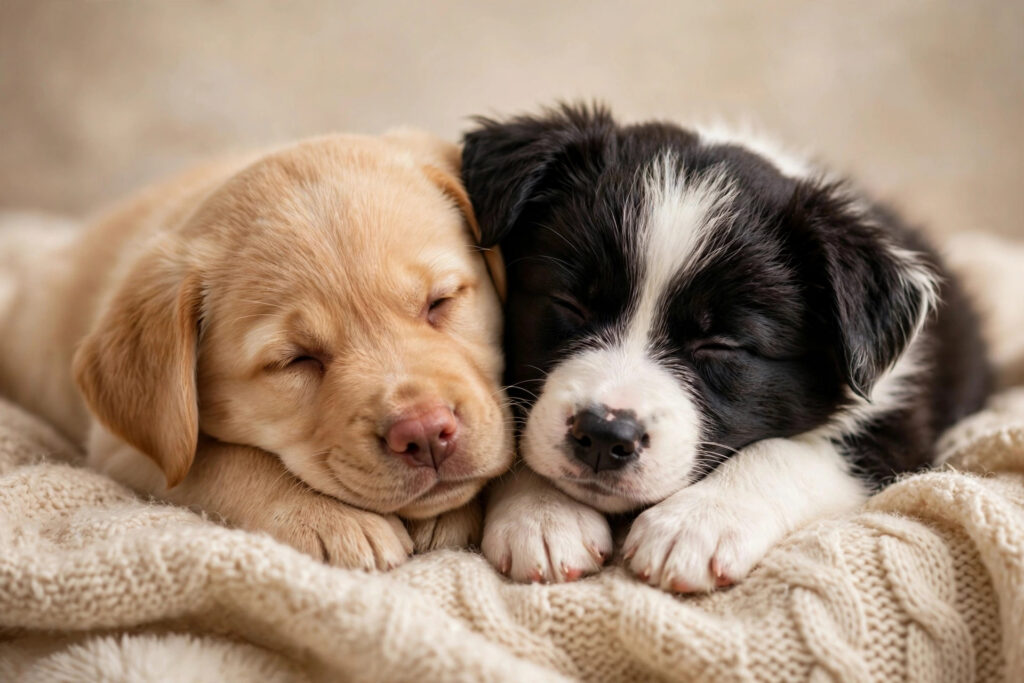
Puppies are adorable, but they can be rude. They jump, nip, bark, and climb all over older dogs. Most older dogs will tolerate this for a while, but even the most patient dog has limits.
Your job is to teach the puppy to be polite. When the puppy plays too roughly, interrupt calmly. Use a cheerful voice to call the puppy to you, reward it for coming, and give it a toy to chew instead. This teaches the puppy that calm behaviour earns good things.
Keep play sessions short: five to ten minutes of gentle play, followed by a rest, is perfect. Puppies get overtired very quickly, and an overtired puppy is a wild puppy. Regular naps help the puppy stay calm and give your older dog a much-needed break.
Also, reward your older dog for being patient. When it stays calm near the puppy, give it a treat and a quiet word of praise, so it links the puppy’s presence with good things.
If you have cats in the home as well, the same slow-and-steady approach applies — our guide on how to introduce a new cat to a dog covers the same gentle principles for a multi-pet household.
Step 5: Build a Daily Routine
Dogs feel safest when life is predictable. A steady routine helps both dogs settle in faster.
Try to keep feeding times, walks, toilet breaks, and bedtimes at roughly the same times each day. Walk the dogs together when you can, because shared walks build a bond. But also give your older dog some one-on-one time with you, just like before — a special walk or a quiet cuddle reassures it that it has not been replaced.
Give the puppy its own training sessions too — just five minutes a few times a day — to teach it its name, to come when called, and to sit politely. A well-trained puppy is much easier for an older dog to live with.
As the days pass, slowly increase the time the dogs spend together. If they choose to lie near each other, play gently, or walk side by side, those are wonderful signs. If they still need space, that is fine too. Every pair of dogs moves at its own pace.
What NOT to Do
Good intentions can still cause problems if the approach is wrong. Here are the most common mistakes to avoid:
Do not force them together. Never hold the dogs close, push them nose to nose, or lock them in a room and hope they sort it out. Forced meetings create fear, not friendship.
Do not punish growling. A growl is a dog’s way of saying, “I need space.” If you scold a dog for growling, it may stop warning you and go straight to a snap or bite instead. When a dog growls, calmly create distance and give it room.
Do not leave them unsupervised too soon. Even if things seem great, do not leave a puppy and an older dog alone together until you are confident they are truly comfortable. This can take weeks. Until then, separate them when you leave the house.
Do not ignore your older dog. It is easy to shower the new puppy with attention and forget the dog that was there first. Keep giving your older dog love, walks, and treats. It needs reassurance most of all.
Do not let the puppy pester endlessly. If the puppy keeps jumping on, nipping, or chasing the older dog, step in. Protecting your older dog is part of your job.
Do not expect instant friendship. Some dogs click right away. Many take weeks or months. Both are normal. Patience is the most important tool you have.
Do not change everything at once. A new puppy is already a big change, so keep your older dog’s bed, feeding spot, and routine as familiar as possible.
When to See a Vet
Most introductions go smoothly with time and patience, but there are times when it is wise to ask a professional for help.
Contact your vet if you notice signs of injury, such as limping, cuts, or bite wounds, after any interaction between the dogs. Even small wounds can become infected, so it is better to have them checked promptly.
Also speak to your vet if your older dog seems unusually stressed for more than a few days — for example, if it stops eating, hides constantly, vomits, has diarrhoea, or seems very lethargic. These can be signs of stress, but they can also be signs of other health problems, and only a vet can tell the difference. Older dogs sometimes have sore joints or poor eyesight that make a bouncy puppy harder to cope with, and a vet can advise on how to make life more comfortable for them.
If the tension between the dogs is not improving after several weeks, or if either dog shows repeated aggression, ask your vet to recommend a qualified dog behaviour professional. A behaviourist can watch the dogs together and give you a plan made for your specific pair.
Remember, this article is general information only. It is not a substitute for professional advice about your own dogs’ health or behaviour.
Frequently Asked Questions
How long does it take for an older dog to accept a puppy?
It depends on the dogs. Some pairs are relaxed together within a few days; others take several weeks or a few months. What matters is steady progress — calmer meetings, longer relaxed time together — not speed.
Should I let the older dog correct the puppy?
A brief, calm growl or snap to say “enough” is normal dog communication. But if corrections are frequent, intense, or leave the puppy frightened, step in, separate the dogs, and shorten future play sessions. Never let corrections turn into real fights.
Can an older dog and a puppy share a crate?
No, not at first — and often never. Each dog should have its own crate and bed. Crates are personal safe spaces, and sharing one can cause stress and arguments. Even dogs that love each other usually prefer their own spot to sleep.
What if my older dog ignores the puppy completely?
Ignoring is often a good sign. It usually means the older dog is not threatened and is simply not interested yet. As long as the older dog is eating, walking, and behaving normally, give it time. If you are introducing a kitten to an older cat, the same patience applies — our guide on how to introduce a kitten to an older cat step by step follows a very similar slow approach.
Should the puppy and older dog walk together every day?
Shared walks are great once both dogs are comfortable, because walking side by side builds a bond. In the early days, keep walks separate if either dog seems stressed, and start with parallel walks at a distance. Always keep giving your older dog some solo walks too.
A Final Word
Introducing a puppy to an older dog is a journey, not a single moment. There will be wobbly days and wonderful days. Your older dog may grumble at first, and your puppy will almost certainly be a whirlwind. That is all normal.
Go slowly, celebrate the small wins, protect your older dog’s rest, teach your puppy good manners, and keep the routine steady. Before long, you may find them sharing a sunny spot on the floor or walking side by side like old friends.
With patience, kindness, and time, most older dogs and puppies do not just learn to live together — they learn to love each other. And that is one of the sweetest things a dog lover can witness.