
Every December it happens: the tree goes up, the lights go on, and within minutes your cat is staring at it like it’s the world’s most exciting new toy. And honestly, from a cat’s point of view, that’s exactly what it is — a tall, sparkly playground covered in dangly things that move when you bat them.
But the one decoration cats find hardest to resist — tinsel — is also one of the most dangerous. Veterinarians deal with tinsel emergencies every holiday season, and some of them end in the operating room. The good news is that with a little planning, you can have a beautiful tree and a safe cat. This guide explains why tinsel is so risky, the warning signs to watch for, and exactly how to cat-proof your Christmas tree without giving up the holiday magic.
Why Tinsel Is So Dangerous for Cats
Tinsel’s danger comes down to a cruel combination of how it looks and how a cat’s body works.
First, cats are wired to chase string-like things. A strip of tinsel is shiny, lightweight, and fluttery — it triggers the same hunting instinct as a ribbon, a shoelace, or a blade of grass. Once a cat starts playing with it, the texture encourages chewing, and chewing can quickly turn into swallowing.
Second, the trouble really starts after the tinsel is swallowed. Long, thin objects like tinsel, ribbon, and yarn can cause what’s called a linear foreign-body obstruction: one end of the strand gets caught — often under the tongue or in the stomach — while the rest keeps traveling through the intestines. the gut bunches up around the strand like fabric on a drawstring, which can damage the intestinal wall and, in serious cases, need emergency surgery.
This isn’t rare: every holiday season, emergency vets treat cats that have swallowed tinsel or ribbon, and the surgery is expensive, invasive, and stressful for both cat and owner. Prevention is far better — keep tinsel something your cat can never reach or chew.
It’s worth noting that tinsel isn’t the only holiday string-hazard. The same risk applies to ribbon curls, gift-wrap ribbon, angel hair, beaded garlands, and even the string on gift tags. If you’re decorating with any long, thin, dangly material, treat it the same way you’d treat tinsel.
For a deeper look at how other seasonal decorations can put pets at risk, see our guide to holiday decorations that can endanger pets — many of the same cat-proofing principles apply year-round.
Signs Your Cat May Have Swallowed Tinsel
Cats are sneaky, so you may never see the moment it happens. Watch for these possible warning signs in the days after your tree goes up:
- Vomiting — especially repeated vomiting, or vomiting that includes a piece of tinsel or string
- Loss of appetite — a cat that suddenly won’t eat, or eats much less than usual
- Lethargy — hiding more than normal, refusing to play, seeming unusually tired
- Drooling — a possible sign something is caught in the mouth or throat
- Straining in the litter box — constipation, diarrhea, or visible discomfort
- Tinsel hanging from the mouth or rear end — this is the telltale sign; never pull it (more on that in “What NOT to Do” below)
One critical note: sometimes a cat that swallows tinsel shows no signs at first. The strand can sit quietly for a day or two before symptoms start. So don’t assume everything is fine just because your cat seems normal an hour after chewing tinsel. Keep watching for a few days, and if anything seems off, call your vet promptly.
If you’re not sure what counts as an emergency, our first-aid guide for pets that swallow something they shouldn’t covers the same calm, quick-response approach for cats.
How to Cat-Proof Your Christmas Tree: A Room-by-Room Plan
1. Secure the tree so it can’t topple
A climbing cat plus a wobbly tree equals a holiday disaster. Use a sturdy, weighted stand, and consider anchoring the tree to the wall or ceiling with clear fishing line — loop it around the trunk near the top and tie it to a wall hook or anchor behind the tree. It’s nearly invisible and can save your tree (and your ornaments) from a full collapse.
Also think about placement: a tree tucked tightly into a corner is harder to climb than one standing in the middle of the room where your cat can get a running start from any side.
2. Skip the tinsel entirely (or keep it out of reach)
The safest option is simply not using tinsel. Modern alternatives give you the same sparkle without the linear-foreign-body risk: try chunky bead garlands, wide ribbon garlands secured tightly to branches, paper chains, or fabric bows. If you love the tinsel look, place tinsel garlands high on the tree — well above your cat’s jumping and swatting range — and never use loose hanging icicle tinsel strands, which are the most tempting kind.
Whatever you choose, keep all unused tinsel, ribbon, and gift-wrap supplies in a closed container, not scattered around a wrapping area your cat can wander into.
3. Decorate the bottom third of the tree with cat-safe ornaments
Cats bat at whatever is at their eye level. Reserve the bottom two to three feet of the tree for decorations that can’t break, shatter, or be chewed into dangerous pieces: soft fabric ornaments, wood ornaments, felt decorations, or pet-safe plastic ones.
Move all glass ornaments to the top half of the tree. A broken glass ornament can cut your cat’s paws or mouth, and tiny shards are hard to spot in carpet. Shatterproof ornaments are a good compromise — they bounce instead of breaking. Hang every ornament securely, hooking it deep into the branch so it can’t be batted off easily.
4. Cover the stand water and hide the cords
The water in a live tree stand can contain sap, preservatives, or fertilizer residue — none of which your cat should drink. Cover the stand with a tree skirt that wraps tightly, or place a piece of foil or a plastic guard over the opening (many cats dislike stepping on foil, which adds a mild deterrent).
Electrical cords are another classic hazard: a cat chewing a light cord risks a burn or an electrical shock. Run cords down the back of the tree, tape them to the floor along the wall, and unplug the lights when you’re not in the room. Battery-operated LED lights are a great alternative — no hot bulbs, no cords, and they stay cool enough that a curious paw won’t get burned.
5. Give your cat a better alternative
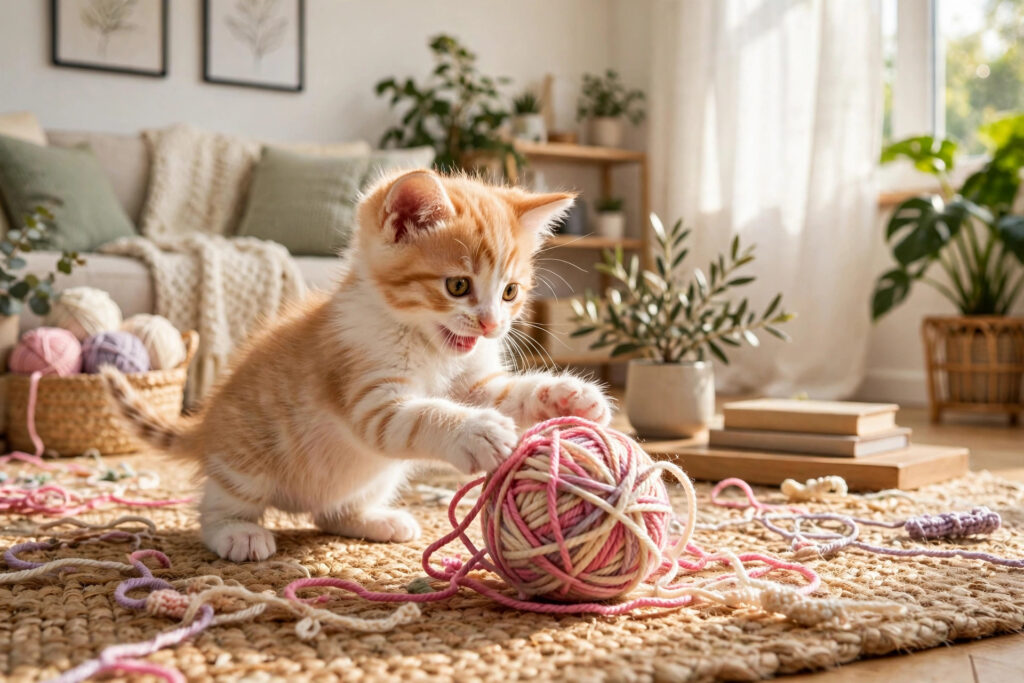
Here’s the secret weapon most people skip: the best cat-proofing is a distracted cat. A bored cat will make the tree its entertainment center; a well-entertained cat often couldn’t care less. In the weeks before the tree goes up, step up playtime — wand toys, crinkle balls, and puzzle feeders all burn off the energy your cat might otherwise spend climbing the branches.
Our indoor cat enrichment ideas has 15 simple boredom-busters that are especially useful during the holidays, when your usual routine gets disrupted by guests, travel, and general chaos. A tired cat is a tree-ignoring cat.
6. Use gentle deterrents around the tree
You don’t need anything harsh — mild deterrents work fine for most cats:
- Aluminum foil around the tree base (most cats hate the texture and sound)
- A citrus-scented spray on the lower branches (cats generally dislike citrus; reapply every few days)
- A motion-activated air canister near the tree for persistent climbers
- A pine or citrus potpourri sachet tucked into the tree skirt
Avoid anything with essential oils that could be toxic to cats — plain citrus peels in a sachet are safer than concentrated oil sprays. And never punish your cat for going near the tree; deterrents plus redirection (a play session away from the tree) work far better than scolding.
What NOT to Do
- Don’t pull tinsel or string from your cat’s mouth or rear end. If you see a strand hanging out, it may be wrapped around something internal. Pulling can saw through the intestinal wall and turn a treatable problem into a life-threatening one. This is the single most important “don’t” in this guide.
- Don’t assume a small piece is harmless. Even a short strand can cause trouble if it anchors badly — any swallowed tinsel deserves a call to your vet.
- Don’t use real candles on or near the tree if you have a cat. A swishing tail near an open flame is a house fire waiting to happen. Battery candles give the same glow with zero risk.
- Don’t leave the tree unwatched in the first week. The novelty wears off — most cats are obsessed for the first few days, then lose interest. Confine your cat to another room when you’re out during that first week.
- Don’t decorate with edible ornaments like popcorn strings, candy canes, or dried fruit garlands. They smell like food, which makes them far more tempting to chew than regular ornaments.
- Don’t let gifts with ribbon sit under the tree for days. Curled ribbon is a top culprit in holiday foreign-body cases. Keep wrapped gifts in a closed room until Christmas morning, or use ribbon-free wrapping.
When to See a Vet
Call your veterinarian or an emergency animal hospital right away if:
- You see tinsel or string hanging from your cat’s mouth or rear end
- Your cat is vomiting repeatedly, especially if you know or suspect tinsel was swallowed
- Your cat stops eating for more than 24 hours
- You notice drooling, gagging, or pawing at the mouth
- Your cat is unusually lethargic, hiding, or seems to be in pain (crying, hunched posture, sensitivity when you touch the belly)
- There’s straining, constipation, or bloody stool
When you call, tell the vet exactly what you saw: what the cat swallowed, how much, and when. If you can, bring a sample of the material (a piece of the same tinsel) so the vet knows what they’re dealing with. Time matters with intestinal obstructions — the earlier your vet can examine your cat, the more treatment options are available, and the better the outcome tends to be.
Remember, this guidance is general information, not a diagnosis. Only your vet, who can examine your cat, can determine what’s actually going on. When in doubt, call — vets would much rather reassure you about a false alarm than treat a problem that waited too long.
FAQ
Can a cat pass tinsel on its own?
Sometimes, yes — a small piece may pass through without trouble. But there’s no way to know in advance whether a strand will pass safely or anchor and cause an obstruction. Because the stakes (emergency surgery) are so high, any known tinsel swallowing is a reason to call your vet, not a wait-and-see situation.
Is ribbon as dangerous as tinsel?
Yes. Any long, thin, flexible material — gift ribbon, curling ribbon, yarn, string, dental floss, rubber bands — carries the same linear foreign-body risk. Tinsel gets the holiday spotlight because it’s everywhere in December, but the rule applies year-round: keep stringy things away from cats.
What Christmas tree is safest for cats?
An artificial tree removes the stand-water problem and the issue of dropped needles (real pine needles can irritate a cat’s mouth and stomach if chewed). If you prefer a real tree, choose one with sturdy branches, keep it well-watered so needles don’t shed as much, and cover the stand water. Either way, anchoring the tree so it can’t fall is the most important safety step.
Are Christmas lights dangerous for cats?
They can be. The main risks are chewing on cords (burns or electric shock) and getting tangled in strands. Use cord covers or route cords where your cat can’t reach them, choose cool-burning LED lights, and always unplug the tree when you’re not home. Never leave a cat unsupervised with the tree lit.
My cat already chewed tinsel — what should I do right now?
Don’t panic, but do act. Check your cat’s mouth gently for any strands you can safely remove (only if they’re loose and easily reached — never pull on anything that’s stuck). Watch closely for vomiting, appetite loss, or lethargy over the next 24–72 hours, and call your vet to describe what happened. If you see string hanging from the mouth or rear, skip the wait and go to the vet immediately.
The Bottom Line
Tinsel looks like harmless holiday sparkle, but to a cat it’s one of December’s real dangers — a swallowed strand can bunch up the intestines and lead to emergency surgery. The fix is wonderfully simple, though: skip the tinsel (or keep it high and unreachable), anchor your tree, move breakables up high, cover the stand water, hide the cords, and give your cat something better to do. Do that, and you get to enjoy your beautiful tree and a healthy, happy cat — which is the whole point of the season. Happy holidays!