
Bringing a puppy home is one of the happiest moments in a new owner’s life — and one of the most tiring. Your little pup zooms around the room like a tiny tornado, then flops down flat and falls asleep mid-step. Ten minutes later, they are up again, ready to play. Is my puppy sleeping too much? Or too little? Is this normal?
The good news is that puppies sleep a lot — far more than most new owners expect. Young puppies spend most of their day asleep, and that is exactly what their growing bodies and brains need. In this guide, we will walk you through how much sleep a puppy needs at each age, why sleep matters so much, how to build a healthy sleep routine, and the signs that mean it is time to call the vet.
How Much Sleep Does a Puppy Need?
A young puppy typically sleeps between 18 and 20 hours a day, including naps. That is not laziness, and it is not a sign that something is wrong. Puppies grow incredibly fast in their first few months, and sleep is when much of that growth happens. While your puppy sleeps, their body releases growth hormones, their brain processes everything they learned, and their immune system gets stronger.
An 8-week-old puppy may only be awake for 4 to 6 hours in a whole day — split into short bursts of play, eating, and exploring. As your puppy grows older, their sleep needs slowly drop, and their awake periods get longer. Puppies also nap in short bursts of 30 minutes to 2 hours, waking often in between — completely normal, much like a baby’s sleep pattern.
Puppy Sleep Needs by Age
Every puppy is a little different, but the general pattern is the same: the younger the puppy, the more sleep they need. Here is a simple age-by-age guide.
8–10 Weeks: 18–20 Hours a Day
At this age, a useful rhythm is about 1 hour awake to 2 hours of rest. After roughly an hour of play, feeding, and a toilet break, your puppy should be settling down for a nap. Do not wait for them to crash on their own — young puppies are terrible at knowing when to stop, and an overtired puppy often turns cranky, nippy, and hard to manage. Enforced naps are one of the kindest things you can do for a young puppy.
3–4 Months: 16–18 Hours a Day
By three or four months old, your puppy is a little more alert and curious, and their sleep needs drop slightly to around 16 to 18 hours a day. Naps may get a little longer and more predictable. This is also the age when many puppies begin to settle into a rough daily routine.
4–6 Months: 14–16 Hours a Day
Between four and six months, your puppy is growing fast and their world is getting bigger. Sleep needs fall to around 14 to 16 hours a day. They can stay awake longer now — sometimes two or three hours at a stretch — and their naps become fewer but deeper. This is also the teething stage for many puppies, and sore gums can make sleep a little restless.
6–12 Months: 12–14 Hours a Day
By six months, your puppy is starting to look and act more like a young adult dog, and their sleep needs are close to adult levels: about 12 to 14 hours a day. Naps during the day get shorter, and most puppies this age can sleep through the night without a toilet break.
Adults: 12–14 Hours a Day
Adult dogs typically sleep 12 to 14 hours a day, including daytime naps. Older dogs and very active working dogs may sleep a little more. So if your puppy’s sleep slowly settles into this range by their first birthday, that is a healthy, normal pattern.
Why Sleep Matters So Much for Puppies
Sleep is not wasted time — it is one of the most important parts of your puppy’s day. Here is what happens while your puppy sleeps.
Growth. Growth hormone is released mainly during deep sleep. Your puppy’s bones, muscles, and organs are developing fast, and sleep gives the body the quiet time it needs to build.
Brain development and learning. Puppies learn a huge amount every day: their name, where to toilet, and how to walk on a lead. During sleep, the brain sorts and stores all of that new information. A well-rested puppy learns faster; a tired puppy forgets what they just learned and struggles to focus.
Mood and behaviour. Have you noticed that your puppy bites more and acts wild when they are tired? Overtired puppies get cranky and bite more, just like overtired toddlers get grumpy. Regular naps keep your puppy calmer, kinder, and easier to train.
In short, sleep is not the opposite of training and play — it is what makes training and play work.
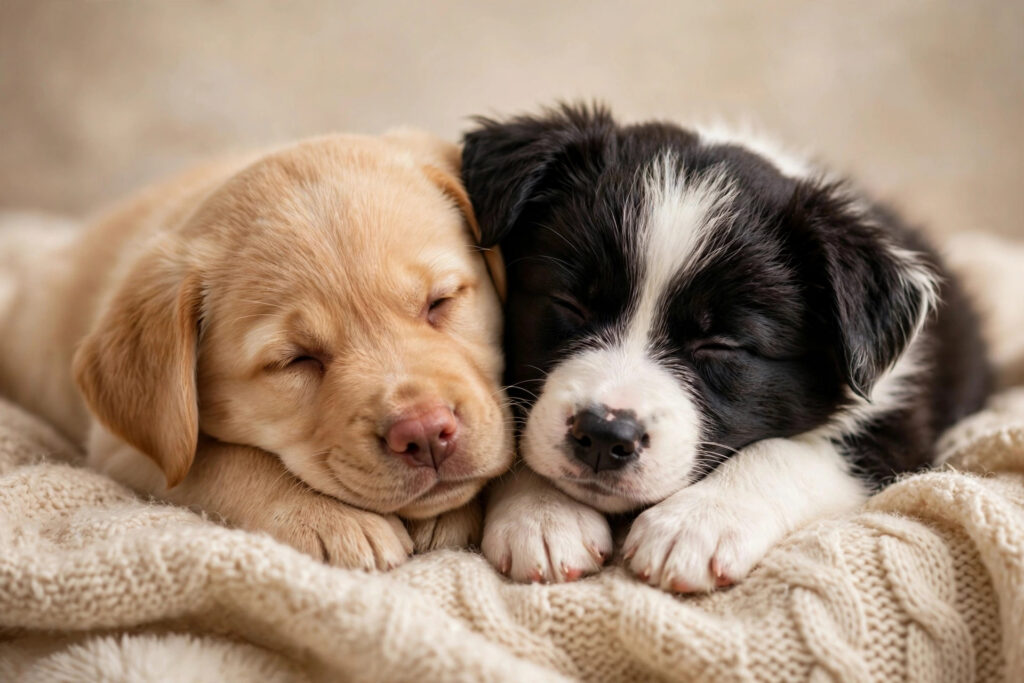
What a Normal Puppy Sleep Pattern Looks Like
If you are a first-time puppy owner, it helps to know what normal actually looks like. A typical day for a young puppy: wake up, toilet break, breakfast, a short burst of play, then a nap; another toilet break, some training or play, lunch, then a long nap; an afternoon play session and another nap; dinner, family time, and then bedtime. At night, they sleep in longer stretches, with one or two toilet breaks for very young puppies.
Most puppies do not sleep through the night until around 16 to 20 weeks old. Before that, they will usually need at least one toilet break during the night. A handy rule of thumb is that a puppy can hold its bladder for roughly one hour per month of age, plus one hour. So a 2-month-old puppy can manage about 3 hours, a 3-month-old about 4 hours, and so on. This is only a rough guide — every puppy is different — but it explains why night waking is normal and expected in the early weeks.
If your puppy wakes at night, keep things calm and boring: a quiet toilet trip in the dark, no play, no excitement, then straight back to bed. Over time, they learn that night is for sleeping. For more detailed help, see our guide on how to train a puppy to sleep through the night.
How to Help Your Puppy Sleep Well
Good sleep does not happen by accident. A few simple habits can make a big difference.
Create a cosy, quiet sleeping spot
Give your puppy a comfortable bed or crate in a calm corner of the house, away from loud noises and heavy foot traffic. A soft blanket that smells like you can help them feel safe. Many puppies sleep best in a crate, because it feels like a den — dark, snug, and safe. If you are crate training, our crate training schedule for an 8-week-old puppy shows you how to build a routine around it.
Use the 1-hour awake, 2-hour rest rhythm
For very young puppies, aim for about one hour awake followed by two hours of rest. When the hour is up, gently guide your puppy to their bed or crate, even if they still seem full of energy. They will often fall asleep within minutes — proof they needed the nap more than they knew. Keep mealtimes, playtime, and bedtime at similar times each day, too: puppies feel secure when they know what comes next.
Tire them out — gently
A puppy who has played, explored, and sniffed new things during the day will sleep better at night. Short training sessions, gentle play, and sniffy walks all help. But do not overdo it: young puppies should not have long, strenuous walks. Our guide on how often to walk a puppy by age explains how much exercise is right at each stage.
Keep bedtime calm
In the hour before bed, wind things down. Dim the lights, keep voices low, and skip the wild games. A short, calm toilet trip right before bed helps your puppy settle for a longer stretch.
What NOT to Do
Some well-meaning habits actually make puppy sleep worse. Avoid these common mistakes:
- Do not wake a sleeping puppy to play. Sleep is when your puppy grows and learns. Let sleeping puppies lie.
- Do not skip naps to “tire them out.” It backfires. An overtired puppy becomes hyper, nippy, and harder to settle, not sleepier.
- Do not use the crate as punishment. The crate should be a safe, happy place. If your puppy only goes in the crate when they have done something wrong, they will never relax in it.
- Do not feed a big meal right before bed. A full stomach and a full bladder make for a restless night. Feed dinner a few hours before bedtime.
- Do not make night wakings exciting. If your puppy wakes at 3 a.m., keep the lights low, stay quiet, and go straight back to bed after the toilet trip. If night time becomes playtime, your puppy will keep waking up for it.
- Do not ignore sudden changes. If a puppy who used to sleep normally suddenly sleeps far more or far less, mention it to your vet.
When to See a Vet
Most puppy sleep patterns are perfectly normal, even when they surprise new owners. But there are times when it is worth getting professional advice. Contact your vet if:
- Your puppy sleeps far outside the ranges in this guide — much more or much less — for more than a day or two.
- Your puppy seems lethargic and hard to wake during the day, or unusually weak and unresponsive.
- Your puppy is sleeping a lot but also eating less, drinking less, or has diarrhoea or vomiting.
- Your puppy suddenly cannot settle at all, paces all night, or seems in pain when lying down.
- Your puppy snores very loudly, gasps, or seems to struggle to breathe while sleeping.
Your vet can check for possible causes such as infections, pain, or other health issues. Never try to diagnose your puppy yourself, and never give medication — including anything meant to help them sleep — without your vet’s guidance.
FAQ
Is it normal for my puppy to sleep 20 hours a day?
Yes, it is completely normal. Young puppies, especially those aged 8 to 10 weeks, typically sleep 18 to 20 hours a day. Sleep supports their growth, brain development, and immune system. As long as your puppy is alert, playful, eating, and drinking normally during their waking hours, long sleep is a sign of a healthy puppy, not a lazy one.
Why does my puppy fall asleep so suddenly?
Puppies have very short energy cycles. They play hard for a short time, then their little bodies need to recharge. Falling asleep mid-play, mid-meal, or halfway across the room is normal for a young puppy. Their sleep-wake system is still developing, and they simply run out of energy fast. As they grow, their awake periods get longer and their naps become more predictable.
When will my puppy sleep through the night?
Most puppies begin to sleep through the night at around 16 to 20 weeks old, though some take a little longer. Before that, they usually need one or two toilet breaks during the night, because their bladders are still small. A consistent bedtime routine and a calm night-time toilet trip will help your puppy learn that night is for sleeping.
Should I wake my puppy up to eat or go to the toilet?
In general, let a sleeping puppy sleep. Most puppies will wake on their own when they are hungry or need the toilet. The exception is very young puppies on a strict feeding schedule, or a puppy your vet has asked you to monitor closely — in those cases, follow your vet’s advice.
My puppy sleeps all day but is wild at night — what can I do?
This is a common problem, and it usually means your puppy’s day and night are out of balance. Try keeping daytime naps to a healthy rhythm (about one hour awake, two hours resting for young puppies), adding gentle play and short training sessions during the day, and keeping evenings calm with a set bedtime. Avoid big exciting play sessions late at night.
Conclusion
Puppies sleep a lot — and that is one of the best things about them. Those 18 to 20 hours of sleep in the early weeks are not wasted time; they are the hours when your puppy grows, learns, and becomes the healthy adult dog they are meant to be. As the weeks pass, the naps get shorter, the play gets longer, and the puppy who once fell asleep in their food bowl becomes a confident young dog who sleeps through the night.
Your job is simple: give your puppy a cosy place to sleep, a steady routine, plenty of gentle play during the day, and calm, boring nights. Enforce naps when they need them, even when they protest.