
You press the power button, the vacuum roars to life, and your cat vanishes. One second she is sitting calmly on the sofa. The next second she is gone — under the bed or behind the washing machine. When the noise finally stops, she creeps out slowly, ears flat and eyes wide, as if you have invited a monster into the house.
If this sounds familiar, you are not alone. A fear of the vacuum is one of the most common fears in cats. Your cat is not being silly. From her point of view, the vacuum is loud, strange-smelling, and moves in a way that makes no sense.
The good news is that you can make cleaning day much easier for her. With a safe hiding place, a little planning, and some slow, gentle training, many cats learn to feel calmer around the vacuum.
Why Vacuums Are So Scary to Cats
To understand your cat’s fear, it helps to see the vacuum through her eyes — and ears.
The Noise Is Much Louder for Them
A vacuum is loud to us, but it is far louder to a cat. Cats hear sounds at much higher frequencies than humans, and their hearing is far more sensitive. A vacuum roars, whines, and rattles. Think about how you feel when a fire alarm goes off right next to you. That is close to what your cat feels every time the vacuum starts.
It Moves in a Strange, Unpredictable Way
Cats are hunters, and they are always watching movement. A vacuum is large, it moves forward and backward without warning, and it comes straight towards them. It has no face and no clear pattern, so your cat cannot read its intentions. Something big that moves towards you without stopping feels like a threat, so running away is the safest choice.
The Smell Is Strange Too
A vacuum picks up dust and pet hair, and it blows warm, dusty air back into the room. To a cat’s powerful nose, that smell is strong and unpleasant. Cats also mark their home with their own scent, and a vacuum can disturb those familiar scents, making the room feel less safe.
Cats Love Routine and Control
Cats are creatures of habit. They like to know where things are and which spots are safe. A vacuum appears without warning and makes a safe, quiet home suddenly loud and chaotic. Many cats also feel trapped if you vacuum a small room with the door closed.
Signs Your Cat Is Scared of the Vacuum
Not every cat runs and hides. Some freeze, some hiss, and some watch from a distance with wide eyes. Here are the most common signs:
- Running and hiding under the bed, into a cupboard, or out of the room.
- Dilated pupils, very large and round even in a bright room.
- Flattened ears, pressed flat or turned sideways like little aeroplane wings.
- Low, crouched body, with the tail tucked tight against the body.
- Puffed-up tail and fur, as she tries to look bigger than she feels.
- Hissing or growling, a warning that means “stay away from me.”
- Freezing in place, staring at the vacuum without moving.
- Hiding long after you finish, sometimes for an hour or more.
Some cats are only mildly worried and will sit on a high shelf and watch. Others are deeply frightened. When cats feel safe, they show it in sweet, open ways — for example, many cats knead with their paws when they are happy. A frightened cat looks very different: tense, low, and ready to run.
What to Do on Cleaning Day
You still need to clean your home, and your cat still needs to feel safe. Plan cleaning day around your cat.
Set Up a Safe Room Before You Start
Before you switch the vacuum on, choose one quiet room where your cat can wait. Put her bed, some water, a litter tray, and a few favourite toys in there, and close the door gently before you start. The closed door blocks most of the noise. Let her stay there until you have finished and the house is quiet again.
Give a Warning and Keep Sessions Short
Cats do not like surprises. Place the vacuum in the room, let her see it sitting still, and let her sniff it if she wants to. Then take her to her safe room before you turn it on. Try not to vacuum the whole house in one long session either. Break the job into shorter parts, one room at a time.
Offer Comfort After You Finish
When the vacuuming is done, go to your cat quietly. Do not pull her out from under the bed. Sit near her hiding spot, speak softly, and let her come to you. Offer a treat or gentle play if she is ready. Some cats bounce back in five minutes. Others need an hour. Stress can also show up later — many owners find that cats get the zoomies at night after a stressful day.
A Step-by-Step Plan to Help Your Cat Get Used to the Vacuum
If your cat is very scared of the vacuum, you can help her slowly get used to it. This process is called desensitisation: introduce the vacuum in tiny, easy steps, over days or weeks. Only move to the next step when your cat is relaxed. If she shows signs of fear, go back a step.
Step 1: The Vacuum Is Off and Still
Start with the vacuum switched off and standing still. Leave the door open so your cat can leave. Put a few treats near it, but not too close. Let her approach, sniff it, and walk away. Repeat for a few days until she walks past it without much worry.
Step 2: Move the Vacuum While It Is Off
Once she is comfortable with the still vacuum, push it slowly across the floor while it is still switched off, as she watches from a safe spot. Give her a treat for staying calm. Never chase her with it, even as a joke.
Step 3: Play a Recorded Vacuum Sound at Low Volume
Now add sound, but keep it very quiet. Play a recording of a vacuum sound at a low volume while your cat is relaxed. Keep it to just a minute or two, and give her treats. Over several days, slowly turn the volume up a little at a time. If she becomes stressed, turn it back down.
Step 4: Switch the Vacuum On Briefly at a Distance
When she is comfortable with the recorded sound, try the real thing. Put her in another room with the door open. Switch the vacuum on for just five or ten seconds, then switch it off, and give her a treat. Repeat over several days, slowly making the sessions longer. Keep the vacuum far away at first.
Step 5: Vacuum a Small Area While She Watches From Far Away
Vacuum a small patch of carpet while your cat watches from a safe distance, such as a high shelf. Keep it short, and give her a treat when you finish. If she stays calm, slowly increase the time and the area. If she runs and hides, go back a step. Some cats reach this stage in two weeks. Others need two months.
Robot Vacuums: A Special Case
Robot vacuums are a different challenge. A normal vacuum is loud and obvious, but a robot vacuum is quiet, low to the ground, and moves on its own. It can sneak up on a cat and bump into her paws. For many cats, that is even scarier.
Run the robot when your cat is in another room. Introduce it slowly: let her sniff it while it is switched off and charging, then run it for a few minutes while she watches from a high shelf. Watch the first few runs closely, and make sure it does not trap her in a corner. If it runs at the same time every day, she will learn the routine. Do not let it run at night, when it can startle a sleeping cat.
How to Make Your Home Feel Safer Overall
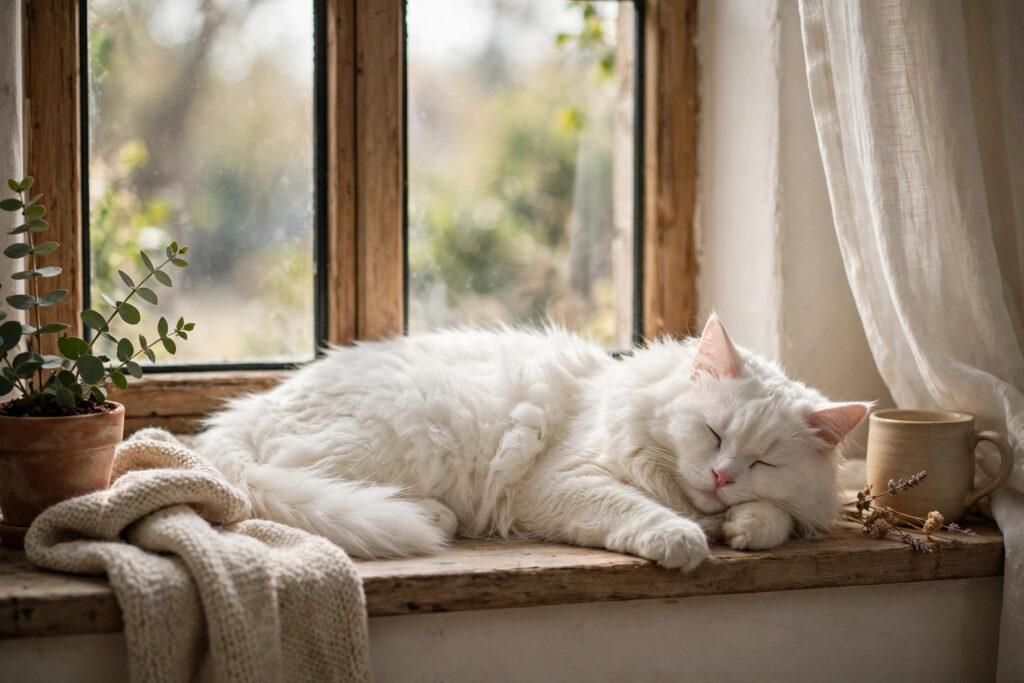
A cat who feels safe in general will cope better with scary sounds. Give her high places to sit, such as a tall cat tree or a shelf, and hiding places too, such as a covered bed or a box with a blanket inside. Keep her routine steady: feed her at the same times and play with her every day. If you work long hours, plan ways to keep your cat entertained while you are at work all day. The same patient approach also works for other new things — for example, the steps used to get your cat used to a carrier without stress use short sessions and treats.
What NOT to Do
- Do not force your cat near the vacuum. Never hold her next to a running vacuum or block her escape route. It will make her more frightened and can break her trust in you.
- Do not chase her with the vacuum, even as a joke. It teaches her that the vacuum hunts her.
- Do not punish her for hiding or hissing. These are normal fear responses, and punishment only adds stress.
- Do not lock her in a small room with a running vacuum. A cat who cannot escape will panic.
- Do not expect instant results. Rushing the steps will overwhelm her.
- Do not use loud music to cover the noise. A calm, quiet house is much better.
- Do not ignore long-lasting fear. If she stays frightened for hours after every clean, ask your vet for advice.
When to See a Vet
Most cats are simply scared of the vacuum, and that fear gets better with time, patience, and a safe room. But talk to your vet if her fear is getting worse; if she stops eating or drinking for more than a day after vacuuming; if she hides for many hours; if she starts toileting outside the litter tray or over-grooming; or if she shows signs of pain, such as limping.
A vet can check for pain, hearing problems, or other health issues that may make your cat more sensitive to noise. They can also talk to you about calming routines and whether a referral to a cat behaviour specialist would help. This article is for general information only and is not a substitute for veterinary advice.
Frequently Asked Questions
Is it normal for cats to be scared of the vacuum cleaner?
Yes, it is very normal. Most cats are scared of vacuums because they are loud, move unpredictably, and smell strange. Cats have much more sensitive hearing than humans, so the noise feels far stronger to them.
Will my cat ever get used to the vacuum?
Many cats do, especially with slow, gentle training and a safe room on cleaning day. Some learn to watch from a distance, and a few learn to ignore it completely. Others will always prefer to hide.
Should I let my cat hide from the vacuum?
Yes. Hiding is a healthy way for a cat to cope with fear. Never drag her out of her hiding place. Make sure she has a safe, comfortable hiding spot, and let her stay there until she is ready to come out.
Can I vacuum when my cat is in the house?
Yes, as long as you plan ahead. Put her in a quiet room with her bed, water, litter tray, and toys, and close the door before you start. Keep the session short, and let her out when the house is quiet again.
Are robot vacuums better or worse for cats?
It depends on the cat. Robot vacuums are quieter, which helps some cats. But they move on their own and can sneak up on a cat, which scares others even more. Introduce the robot slowly, run it when she is in another room at first, and watch how she reacts.
Conclusion
Your cat is not scared of the vacuum to annoy you. She is scared because, to her sensitive ears, the vacuum is loud, strange, and unpredictable. Her instinct is to run and hide, and that instinct is keeping her safe.
You can help her feel better. Give her a safe room on cleaning day. Keep sessions short. Let her hide without punishment. And if you want to help her get braver, take the slow, step-by-step path: a still vacuum, then a moving vacuum, then a quiet recording, then a short burst of real sound at a distance.
Some cats will learn to watch the vacuum calmly from a high shelf. Others will always dash for the bedroom the moment they hear it start. Both are fine. What matters is that your cat trusts you to keep her safe, and that she knows she always has a quiet place to go.