
You are sitting on the couch, maybe watching a show or scrolling your phone, when your cat climbs onto your lap. Then it starts. Those front paws push in and out, in and out, in a steady rhythm — like your cat is kneading dough. Sometimes there is a soft purr with it. Sometimes the claws come out and you feel every little prick through your jeans.
If you have ever wondered why your cat does this, you are not alone. Almost every cat owner sees it, and the good news is: kneading is almost always a good sign.
In this guide, we will walk through 8 reasons your cat may be kneading, plus simple ways to make it comfortable for both of you — and when a change in the habit is worth a call to your vet.
What Is Kneading, Exactly?
Kneading is a rhythmic pushing motion cats make with their front paws, alternating left and right. It looks a lot like kneading bread dough, which is how it got its name. Some people also call it “making biscuits” or “happy paws.”
Most cats knead soft surfaces — blankets, pillows, sweaters, your lap. Many purr while they do it, and some drool a little too. Claws may stay in or come out depending on how deeply the cat gets into the motion. Almost every cat kneads at some point — it starts in kittenhood and usually continues for life.
Reason 1: It Started as a Kitten Nursing Habit
Newborn kittens knead their mother’s belly while nursing — the pushing motion helps milk flow, and it is paired with the warmth and comfort of feeding time. That early experience creates a strong positive association: for a cat, kneading is linked to the safest moments of its earliest days.
This is also why many cats knead before settling down to sleep — the motion can be part of a bedtime routine, like a person fluffing a pillow before lying down.
Reason 2: Your Cat Is Happy and Relaxed
Kneading is one of the clearest signs of a content cat. When a cat kneads, it is usually feeling safe, calm, and relaxed — and the purring that often comes with it signals the same thing.
Many owners notice their cats knead most during quiet, peaceful moments: an evening on the couch, a sunny nap spot, or a gentle petting session. The cat is not asking for anything — it is simply enjoying the moment. If your cat kneads you, take it as a compliment. A nervous or frightened cat does not usually knead.
Reason 3: It Is a Way of Showing Affection
Cats have their own love language, and kneading is a big part of it. Some behaviorists believe that when an adult cat kneads a person, it is treating that person the way it once treated its mother.
This is why many cats knead their favorite person more than anyone else in the household. If your cat climbs past three other family members to knead on your lap, that is not random. You are the chosen one.
Cats pair kneading with other affection behaviors too — slow blinks, head-butting, and rubbing their face against you. If you notice your cat staring at you softly while kneading, you may enjoy reading about why cats stare at their owners — it is often another sign of the same bond.
Reason 4: Your Cat Is Marking You as Theirs
Here is one many people do not know: cats have scent glands in their paw pads. When a cat kneads, it presses those glands into the surface, leaving its scent behind.
In the wild, scent marking helps cats claim territory and signal “this is mine, and it is safe.” Your home cat is doing the same thing on a smaller scale. When your cat kneads your lap, your blanket, or your favorite sweater, it is leaving a little scent signature that says this spot — and this person — belongs to them.
This is also part of why some cats knead one particular blanket obsessively. That item now smells like them, which makes it feel safe, which makes them knead it more. It is a cozy little cycle.
Reason 5: Your Cat Is Preparing a Comfy Sleeping Spot
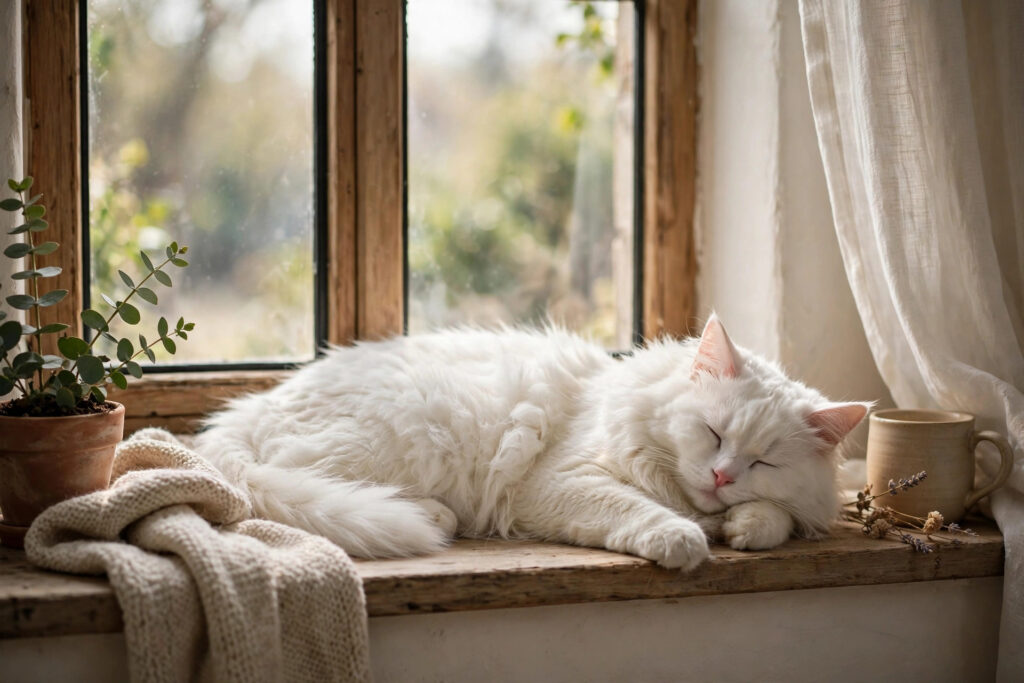
Watch a cat about to settle down for a nap and you may see a familiar routine: circle a few times, knead the surface, then flop down. Some experts believe this goes back to wild ancestors, who would pat down grass or leaves to make a soft, safe sleeping nest.
Your indoor cat does not need to flatten any grass, but the instinct can linger. Kneading before sleep may be your cat’s way of testing the surface and making it “just right.”
If your cat kneads and then sleeps on you, congratulations — you are now officially a cat bed.
Reason 6: Kneading Helps Your Cat Relax When Stressed
Not all kneading happens in happy moments. Sometimes cats knead to calm themselves down. Like a person squeezing a stress ball or rocking gently, the repetitive motion can be soothing when a cat feels uneasy.
You might see this kind of kneading after something stressful — a loud noise, a vet visit, or a change in routine. The cat retreats to a safe spot and kneads steadily until it feels better. This is normal and healthy — kneading is a coping tool. That said, if your cat suddenly kneads much more than usual alongside other changes like hiding or not eating, that combination is worth paying attention to (see “When to See a Vet” below).
Reason 7: Your Cat Learned It Gets a Reaction
Cats are smart observers. If kneading your lap has always earned gentle petting, sweet talk, and attention, your cat may have learned that kneading is a great way to get those things. Kneading becomes part of the “how to get loved on” toolkit.
There is nothing wrong with this. It is simply how cats and people train each other, day after day, without either side realizing it.
This learned pattern is also why some cats knead right before mealtime. Cats that follow their owners from room to room are often using the same approach — you can learn more about why cats follow their owners everywhere and what they are trying to tell you.
Reason 8: Hormones and Deep Instinct
In unspayed female cats, kneading can sometimes be linked to heat cycles, since the behavior is tied to mating and nesting instincts. Some cats knead more during these times. Spaying usually reduces this pattern, along with the other signs of heat.
Because it is so deeply rooted, most cats will knead their whole lives. Kittens knead, adults knead, and senior cats knead. The rhythm may slow down with age, but the habit rarely disappears completely.
Practical Tips: Making Kneading Comfortable for Both of You
Kneading is sweet, but those claws can hurt. Here are simple ways to keep kneading pleasant:
Keep a kneading blanket handy. Place a thick, soft blanket on your lap when your cat comes to knead. Many cats happily transfer their kneading to the blanket, and over time may learn the blanket is the kneading spot.
Keep claws trimmed. Regular nail trims make kneading painless for you and safer for furniture. Trim just the sharp tip, and if you are unsure how, ask your vet or groomer to show you the first time. Never declaw — it is painful and can cause long-term behavior problems.
Do not punish the kneading. Pushing your cat away or scolding it for kneading can damage trust — the cat is showing affection and comfort. Instead of stopping the behavior, redirect it: gently slide a blanket under those paws.
Give your cat good kneading surfaces. Soft beds, plush blankets, and even a worn T-shirt that smells like you can become favorite kneading spots.
Make the home enriching. A cat with plenty to do is a relaxed cat. Puzzle feeders, scratching posts, window perches, and play sessions all help. For ideas, check out these simple indoor enrichment ideas to keep your cat happy and active.
What NOT to Do
Kneading is almost always harmless, but a few common reactions can cause problems:
Do not declaw your cat to stop kneading. Declawing is not a nail trim — it is the amputation of the last bone of each toe. It causes pain and is linked to litter box avoidance and biting. Trimming nails and using a blanket are kinder solutions.
Do not yell at or punish your cat for kneading. Kneading is a comfort behavior, not misbehavior. Punishment confuses the cat and can make it anxious around you. If the claws bother you, redirect rather than reprimand.
Do not push your cat off roughly. A sudden shove while your cat is in a blissful kneading state can startle it and break trust. If you need to get up, gently lift the cat or slide it onto a soft surface nearby.
Do not ignore a sudden, dramatic change in kneading. A cat that has kneaded daily for years and suddenly stops — or a cat that suddenly kneads obsessively and cannot seem to settle — may be telling you something changed. One odd day is fine. A lasting pattern shift deserves attention (see below).
When to See a Vet
Kneading itself is not a medical problem, but changes around it can sometimes be early clues that something is off. Call your vet if you notice:
- A sudden stop in kneading in a cat that has always kneaded, especially if paired with hiding, loss of appetite, or less movement. Possible causes include pain (arthritis is common in older cats), illness, or stress.
- Obsessive, nonstop kneading where the cat seems unable to relax, especially combined with restlessness or pacing. Possible causes include anxiety, pain, or cognitive changes in senior cats.
- Kneading one area of the body repeatedly, such as pressing paws into its own belly or side. This can occasionally be a sign of localized discomfort.
- Limping, swelling, or sensitivity in the paws that appears alongside kneading changes. Possible causes include an injured claw, a thorn or splinter, or paw pad irritation.
- Any sudden behavior change that lasts more than a day or two — eating less, drinking more, vomiting, or withdrawing. These are general signs worth checking, whatever the kneading situation.
This is not a diagnosis list — only your vet can determine what is going on with your cat. But you know your cat’s normal habits better than anyone, and a change in a lifelong behavior like kneading is worth mentioning at your next visit, or sooner if other symptoms appear.
Frequently Asked Questions
Why does my cat knead me and not anyone else?
Your cat has likely chosen you as its favorite person. Kneading is linked to comfort and trust, so cats tend to knead the person they feel safest with. It can also be learned — if you have always responded warmly to kneading, your cat knows it works on you.
Why does my cat knead with its claws out?
Claws often come out when a cat gets deeply into the kneading rhythm, similar to how they would grip while nursing as a kitten. It is not aggression — keeping nails trimmed and placing a thick blanket on your lap solves most of the discomfort.
Why does my cat knead and drool at the same time?
Drooling during kneading is common, especially in younger cats, and it goes back to the nursing association — kittens drool a little while feeding. A small amount of drool during happy kneading is usually nothing to worry about. Mention it to your vet if the drooling is heavy or happens outside of kneading.
Why does my cat knead blankets but never people?
Some cats simply prefer the texture of blankets, or they may be a bit shy about close contact while in that vulnerable, relaxed state. It is a personality thing, not a sign that your cat likes you less.
Is it normal for an older cat to still knead?
Yes, completely normal. Kneading often continues for a cat’s entire life. In senior cats the rhythm may get slower and gentler, which is a normal part of aging. What matters more than the kneading itself is whether the overall pattern changes suddenly — that is when a vet check is a good idea.
Conclusion
So, why does your cat knead with its paws? Most of the time, the answer is beautifully simple: your cat is happy, comfortable, and feels safe with you. The behavior reaches back to the earliest days of kittenhood and doubles as a self-soothing ritual and a love note to its favorite person — you.
The next time those paws start their steady rhythm on your lap, just enjoy it. Keep a soft blanket nearby, keep those claws trimmed, and take the purring as the compliment it is.